

Herstellung und Charakterisierung von polymermodifizierten Templatphasen
Doppelschichtmembransysteme
Durch den Zusatz wasserlöslicher Polymere kann das Strukturbildungsverhalten von lyotrop flüssigkristallinen Systemen maßgeblich beeinflusst werden [6, 7, 10, 11, 13].
Der Eintrag entgegensetzt geladener Polyelektrolyte führt beispielsweise zur Ausbildung kompakter multilamellarer Vesikelstrukturen mit stark verändertem Quellvermögen [8-10].
Durch Zusatz verzweigter zuckermodifizierter Polyethylenimine kann eine morphologische Umwandlung von einer Vesikelphase in eine tubuläre Netzwerkstruktur induziert werden [12].
Polyampholyte, wie z.B. PalPhBisCarb, können ähnliche Effekte einer Morphogenese auslösen, wie wir kürzlich zeigen konnten [14]. Die resultierende Templatphase kann zur gezielten Herstellung von flachen Goldnanodreiecken eingesetzt werden [15].
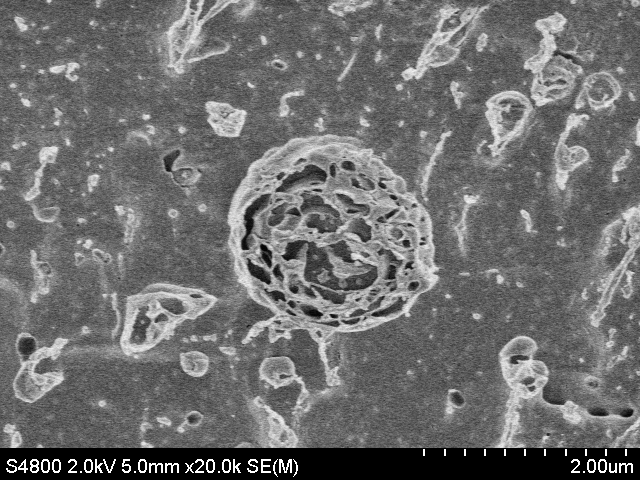
Bild 1: Kryo-Rasterelektronenmikroskopische Aufnahme einer vesikulären Templatphase
Kooperation:
- Prof. S.E. Friberg (Clarkson University, USA)
- Prof. Th. Hellweg (Universität Bayreuth)
- Prof. E. Kleinpeter (Universität Potsdam)
- Dr. D. Appelhans (Leibniz Institut, Dresden)
Ausgewählte Publikationen:
| [6] |
S. Kosmella, J. Kötz, S.E. Friberg, R.A. Mackay Interactions of Polyelectrolytes with the Lyotropic Liquid Crystalline System Na-dodecylsulfate / Decanol / Water Ber. Bunsenges. Phys. Chem. 100 (1996) 6, 1059-1063 | DOI: 10.1002/bbpc.19961000659 |
| [7] |
D. Ruppelt, J. Kötz, W. Jaeger, S.E. Friberg, R.E. Mackay The Influence of Cationic Polyelectrolytes on Structure Formation in Lamellar Liquid Crystalline Systems Langmuir 13 (1997) 3316-3319 | DOI: 10.1021/la9610258 |
| [8] |
N. Bechthold, B. Tiersch, J. Kötz, S.E. Friberg Structure Formation in Polymer-Modified Liquid Crystals J. Colloid and Interface Sci. 215 (1999) 106-113 | DOI: 10.1006/jcis.1999.6199 |
| [9] |
J. Kötz, B. Tiersch, I. Bogen Polyelectrolyte induced vesicle-formation in lamellar liquid crystalline model systems Colloid & Polymer Sci. 278 (2000) 164-168 | DOI: 10.1007/s003960050027 |
| [10] |
Th. Hellweg, A. Brulet, D. Robertson, J. Koetz Temperature and Polymer Induced Structural Changes in SDS/Decanol Based Multilamellar Vesicles Phys. Chem. Chem. Phys. 4 (2002) 2612-2616 | DOI: 10.1039/B109643P |
| [11] |
D. Robertson, Th. Hellweg, B. Tiersch, J. Koetz Polymer induced structural changes in lecithin/SDS-based multilamellar vesicles J. Colloid and Interface Sci. 270 (2004) 187-194 | DOI: 10.1016/j.jcis.2003.09.013 |
| [12] |
A. Köth, D. Appelhans, D. Robertson, B. Tiersch, J. Koetz Use of Weakly Cationic Dendritic Glycopolymer for Morphological Transformation of Phospholipid Vesicles into Tube-like Network Soft Matter (2011) 7, 10581-10584 | DOI: 10.1039/C1SM06439H |
| [13] |
J. Koetz, S. Kosmella Polymers in lyotropic liquid crystalline systems In A. Hubbard: Encyclopedia of Surface and Colloid Science Second Edition; Taylor & Francis: New York (2006) 6, 5017-5022 | ISBN: 978-0-8493-9615-1 |
| [14] |
N. Schulze, C. Prietzel, J. Koetz: Polyampholyte mediated synthesis of anisotropic gold nanoplatelets, Colloid & Polymer Sci. 294 (2016) 8, 1297-1304 | DOI: 10.1007/s00396-016-3890-y |
| [15] |
N. Schulze, D. Appelhans, B. Tiersch, J. Koetz: Morphological transformation of vesicles into network structures by adding polyampholytes, Colloids and Surfaces A 457 (2014) 326-332 | DOI: 10.1016/j.colsurfa.2014.06.007 |
Mikroemulsionen
Polymere können in Mikroemulsionen, das heißt thermodynamisch stabile Öl-Wasser-Tensid-Cotensid-Gemische, eingebracht werden, ohne dass eine makroskopische Phasenseparation einsetzt.
Polymere können dabei die Stabilität des Tensidfilms erhöhen [16, 20], den Phasenbereich der Mikroemulsion vergrößern [18, 19] oder die Bildung einer bikontinuirlichen Mikroemulsion induzieren [16, 17].
In Gegenwart von Polyampholyten kann die Stabilität des Tensidfilms durch Variation des ph-Wertes gezielt eingestellt werden [3].
Kooperation:
- Prof. S.E. Friberg (Clarkson University, USA)
- Dr. A. Poghosyan (Academy of Science Yerevan, Armenia)
- Prof. E. Kleinpeter (Universität Potsdam)
Ausgewählte Publikationen:
| [16] |
T. Beitz, J. Kötz, S.E. Friberg Polymer-modified Ionic Microemulsions Formed in the System SDS/ Water/ Xylene/ Pentanol Progress in Colloid & Polymer Sci. (1998) 111, 100-106 | DOI: 10.1007/BFb0118117 |
| [17] |
T. Beitz, J. Kötz, G. Wolf, E. Kleinpeter, S.E. Friberg Poly(N-vinyl-2-pyrrolidone) and 1-Octyl-2-pyrrolidone modified Ionic Microemulsions J. Colloid and Interface Sci. 240 (2001) 581-589 | DOI: 10.1006/jcis.2001.7635 |
| [18] |
C. Note, J. Ruffin, B. Tiersch, J. Koetz The influence of polyampholytes on the phase behaviour of microemulsions used as template for the nanoparticle formation J. Dispersion Sci. And Technology 28 (2007) 1, 155-164 | DOI: 10.1080/01932690600992217 |
| [19] |
M. Fechner, M. Kramer, E. Kleinpeter, J. Koetz Polyampholyte-modified ionic microemulsions Colloid & Polymer Sci. 215 (1999) 106-113287 (2009) 1145-1153 | DOI: 10.1007/s00396-009-2074-4 |
| [20] |
A. Poghosyan, L. Arsenyan, H. Gharabekyan, S. Falkenhagen, J. Koetz, A. Shahinyan The molecular dynamics simulation of inverse sodium dodecylsulfate (SDS) micelles in toluene/pentanol solute in absence and presence of poly(diallyldimethyl ammonium chloride) (PDADMAC) J. Colloid and Interface Sci. 358 (2011) 175-181 | DOI: 10.1016/j.jcis.2011.01.091 |
Janus-Emulsionen
Emulgiert man zwei nicht-mischbare Öl-Komponenten und Wasser in Gegenwart von grenzflächenaktiven Substanzen, können sogenannte Janus-Emulsionen entstehen. Das nachstehende Bild zeigt eine lichtmikroskopische Aufnahme einer solchen Janus-Emulsion.
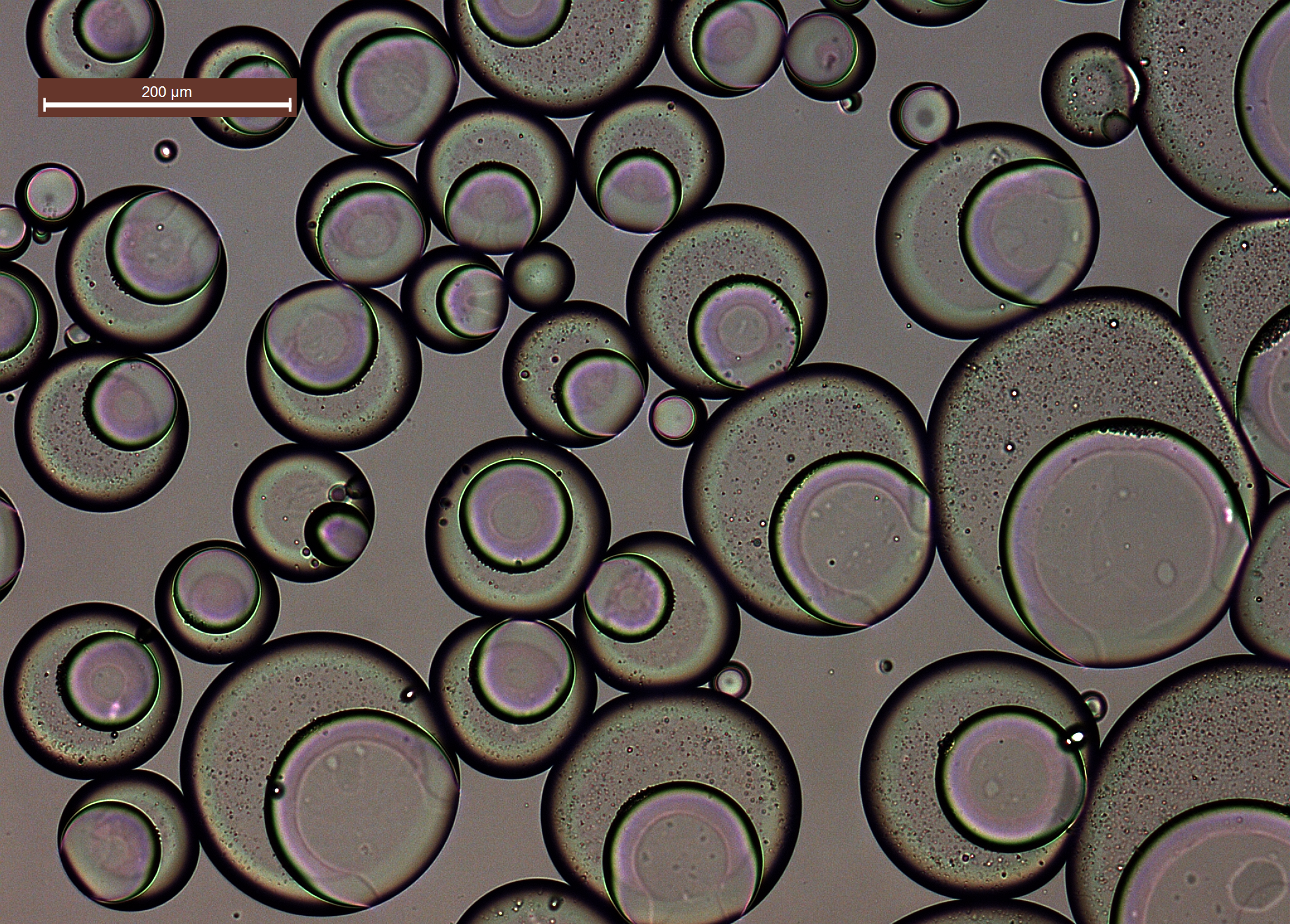
Bild 2: Lichtmikroskopische Aufnahme einer Janus-Emulsion
Erste Arbeiten von Friberg et al. haben gezeigt, dass nichtionische Tenside (z.B. Tween 80) derartige Öl1/Öl2-Tropfen stabilisieren können [21-23].
Unsere Untersuchungen belegen, dass die Tröpfchengröße verkleinert werden kann bei Zusatz von Phospholipiden [24]. Darüber hinaus gelingt es, Janus-Emulsionen in Gegenwart von Gelatine-Chitosan-Gemischen zu stabilisieren [25]. Die resultierenden Janus-Emulsionen dienen als Templatphase für die Herstellung von bioabbaubaren Scaffold-Materialien [26].
Kooperation:
- Prof. S.E. Friberg (Clarkson University, USA)
Ausgewählte Publikationen:
| [21] |
S.E. Friberg, I. Kovach, J. Koetz: Equilibrium topology and partial inversion of janus drops: A numerical analysis, Chem. Phys. Chem. 14 (2013) 16, 3772-3776 | DOI: 10.1002/cphc.201300635 |
| [22] |
H. Hasinovic, S. E. Friberg, I. Kovach, J. Koetz: Destabilization of a dual emulsion to form a Janus emulsion, Colloid & Polymer Sci. (2014) online | DOI: 10.1007/s00396-014-3263-3 |
| [23] |
H. Hasinovic, S.E. Friberg, I. Kovach, J. Koetz: Janus emulsions drops: equilibrium calculations, J. Dispersion Sci. Technology 34 (2013) 1683-1689 | DOI: 10.1080/01932691.2013.763728 |
| [24] |
I. Kovach, J. Koetz, S.E. Friberg: Janus emulsions stabilized by phospholipids, Colloids and Surfaces A 441 (2014) 66-71 | DOI: 10.1016/j.colsurfa.2013.08.065 |
| [25] |
I. Kovach, J. Won, S.E. Friberg, J. Koetz: Completely engulfed olive/silicone oil Janus emulsions with gelatin and chitosan, Colloid & Polymer Sci. 294 (2016) 4, 705-713 | DOI: 10.1007/s00396-016-3828-4 |
| [26] |
I. Kovach, J. Rumschöttel, S.E. Friberg, J. Koetz: Janus emulsions mediated porous scaffold bio-fabrication, Colloids and Surfaces B 145 (2016) 347-352 | DOI: 10.1016/j.colsurfb.2016.05.018 |